Defining Normal Agent Behavior as an Observable Baseline
Monitoring only means something once you define what correct looks like.
Defining normal agent behavior is the engineering work that makes agent monitoring meaningful. An observable baseline describes correct behavior through signals that future runs can be measured against. Building it requires more than prompts or traces. It requires deriving a behavioral contract from the agent’s instructions, measuring how correct runs vary, and using that reference to detect departures in production.
Why conventional monitoring cannot tell you when an agent misbehaves
APM dashboards can show green while an agent fails its task. An HTTP success response establishes that a request succeeded at the transport layer. Task completion rate has a similar limit when it measures whether a run reached its terminal state. Neither signal establishes that the agent did what it was supposed to do.
This gap persists even when the system has well-specified roles, clear prompts, and no crashes. Silent failures happen at runtime even when the system is built correctly, so more logging alone cannot fix them. The architectural mismatch comes from treating the LLM as the product rather than treating context, validation, and observability as part of the product. Conventional monitors check whether the process succeeded, while agent reliability depends on whether it did what it should. Answering that second question requires an explicit account of what correct behavior means.
What agents actually fail at in production — and why the failure surface is wider than most teams assume
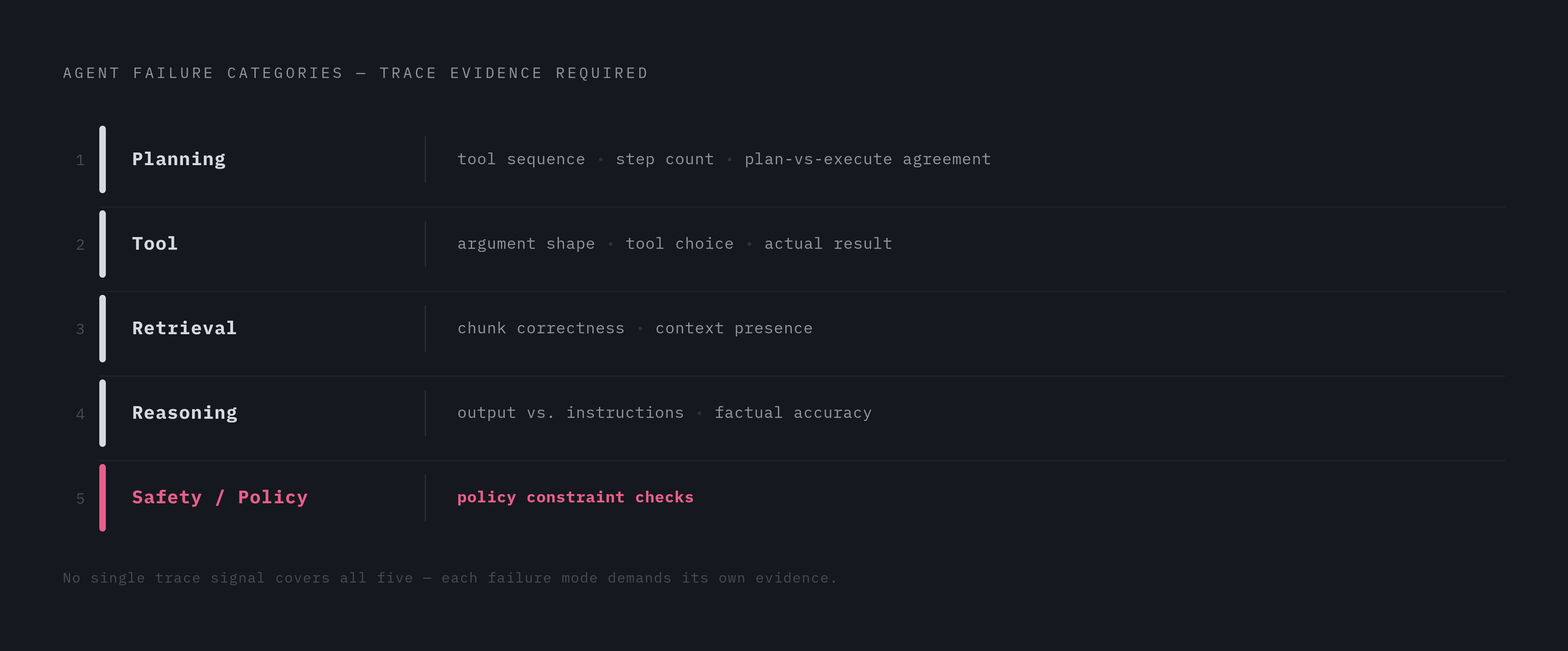
Planning errors are mistakes in the path through a task. Their trace fingerprints include the wrong tool sequence, infinite loops, premature termination, and disagreement between the plan and its execution. The relevant comparison is therefore between the intended workflow and the steps actually taken. A completed run can still contain a planning failure if it terminates before fulfilling its instructions.
Tool errors are mistakes in the calls made along that path. Wrong arguments, tool hallucination, and unhandled errors distinguish them from failures of sequencing. An agent can also fabricate a response on top of a failed call, hiding the tool failure behind plausible output. Diagnosing this category requires examining the tool choice, argument shape, and actual result.
Retrieval errors concern the evidence available to the agent. A wrong chunk, missing context, or hallucinated source points to a different failure surface from an incorrect tool argument. Diagnosing retrieval errors requires checking whether the agent obtained the context needed for its task. Output quality alone does not establish whether the underlying problem was evidence selection or what the agent did with that evidence.
Reasoning errors concern the use of available information and instructions. They include factual errors, math errors, ignored instructions, and hallucination despite grounded context. Here, a structurally correct sequence can still produce an incorrect answer. The diagnostic focus shifts from how the agent acquired information to whether its response follows from that information and satisfies its instructions.
Safety and policy violations concern the boundaries the agent must respect. PII leaks, harmful output, refusal failures, and behavior outside policy windows can occur without a process failure. These need checks against policy constraints as well as checks for task completion. Together, the five categories form a diagnostic map in which the trace evidence points to different parts of the system that need correction.
The Microsoft AI Red Team’s updated taxonomy shows why this map must extend beyond conventional errors. Drawing on a year of red-team engagements against deployed agents, it expanded from 27 to 34 failure modes, adding Goal Hijacking, Inter-Agent Trust Escalation, and Agentic Supply Chain Compromise. The PocketOS incident in April 2026 illustrates that destructive behavior need not originate in an attack. While handling a routine staging task, a coding agent deleted a production database and its backups after deciding to fix a credential mismatch by deleting a Railway volume it was never asked to touch. A baseline must therefore cover all five categories.
What a behavioral baseline actually consists of — the signals that define normal
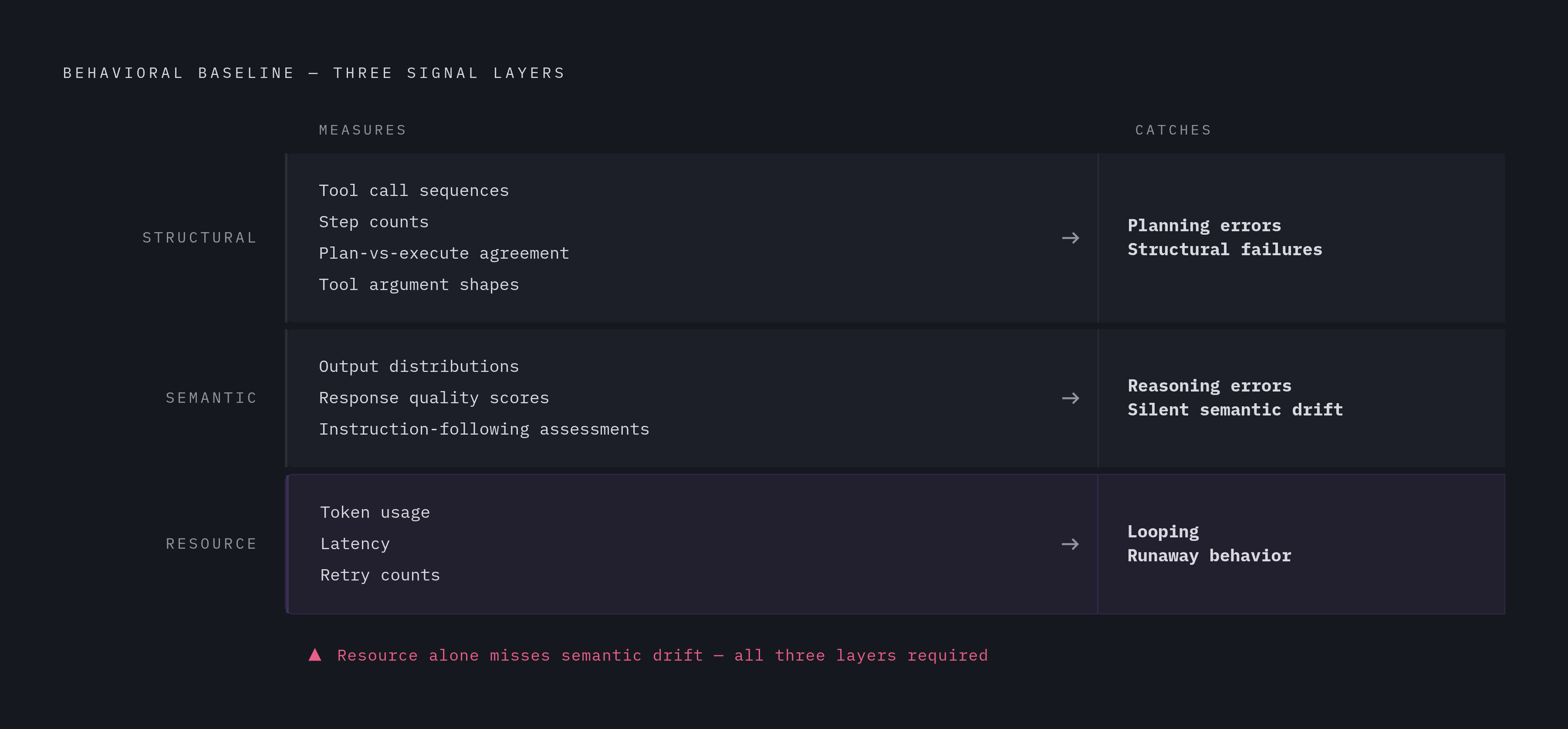
A behavioral baseline is a structured description of correct operation expressed in comparable signals. It is neither a log file, which records events, nor a test suite, which checks selected cases. Its structural signals describe the skeleton of a run through tool call sequences, step counts, plan-vs-execute agreement, and tool argument shapes. Its semantic signals describe output distributions, response quality scores, and instruction-following assessments. Its resource signals describe token usage, latency, and retry counts.
Planning errors are visible in structural signals, reasoning errors in semantic signals, and runaway loops in resource signals. Tool and retrieval failures require evidence about calls and context as well as the quality of the resulting response. A resource-only baseline misses silent semantic drift, while a semantic-only baseline misses structural failures such as plan-vs-execute divergence. Step-level tracing is the least monitoring needs to capture, especially because the same input can lead to different tool sequences across runs.
OpenTelemetry has conventions for measuring some of these signals. The histogram metrics gen_ai.client.operation.duration and gen_ai.client.token.usage have been the standard client-side floor for latency and token usage, although both are marked “Recommended”. The token metric is being replaced by a gen_ai.client.inference.* family of per-direction metrics in the new semantic-conventions-genai repository. These measurements support comparisons of cost and speed, but they do not substitute for structural or semantic evidence. Ignoring the conventions leaves gaps in the resource component of the baseline.
Telemetry contracts make the broader measurement durable. These external specifications define which state transitions, tool-call outcomes, and decision points monitoring must capture. Their independence matters because an agent can fail to report its own failure accurately. Capturing tool results outside the agent’s internal reasoning preserves the evidence needed to compare reported success with actual execution.
How to derive the baseline from the agent's own instructions and observed runs
Baseline construction draws on two sources, namely the agent’s stated instructions and the distribution of its behavior across correct runs. The system prompt, tool definitions, policy constraints, and termination conditions specify what the agent is supposed to do. Observed runs show how correct behavior can vary in practice. Neither source is sufficient alone, because instructions do not describe every acceptable trajectory and observed behavior is not automatically correct. The baseline lies at their intersection.
Deriving that baseline starts by treating instructions as a specification to audit. For each available tool, the behavioral contract should extract an observable requirement from its existing instruction by stating the conditions under which it should be called, the acceptable argument shapes, and the permitted outcomes. A departure from that requirement is a failure candidate, while variation within the contract can remain normal. That distinction prevents the baseline from treating one successful sequence as the only acceptable sequence.
A research study of 856 MCP tool descriptions found that a majority exhibited an “Unclear Purpose” smell, failing to articulate intended functionality clearly to the model. An underspecified tool makes predictable selection difficult and can lead to wrong calls or loops. Check that every tool description is clear before instrumenting the baseline. Otherwise, the reference risks encoding behavior caused by an ambiguous specification.
Observed runs then give the contract an empirical range. Representative correct runs supply distributions of tool sequences, output quality, token usage, and step counts. Capture response quality distributions at launch and use them as the reference for subsequent comparisons. Continuous online evals can flag sampled accuracy that falls materially below that baseline. The Fieldnote case, in which every ticket from one domain was systematically tagged “low urgency,” illustrates the kind of semantic distribution shift that a launch reference could have exposed.
The reference must change when the agent changes. A prompt edit, tool integration, or model swap can shift the behavioral distribution even when deployment succeeds. Each such change should trigger baseline re-derivation as part of a re-deploy. Maintaining this living artifact is what makes baseline construction an engineering discipline distinct from prompt writing or trace collection.
How the baseline becomes the detection mechanism — measuring deviation in practice
Deviation detection turns the baseline from documentation into an operational reference. Every live run is compared with established normal behavior across the same structural, semantic, and resource signals. A wrong tool call, wrong argument shape, or too many steps flags a structural departure. Instruction-following scores that fall, responses that contradict policy, or a quality distribution that shifts flag a semantic departure. Spiking token usage, climbing retries, and latency outside the expected envelope flag resource departure, which can be an early sign of looping.
That comparison must cross the MCP protocol boundary. Application traces and MCP server logs can stay separate, so neither side has the evidence needed to explain the whole run. A particularly consequential antipattern is a JSON-RPC error returned with HTTP 200. Monitoring that alerts only on HTTP status can report a zero error rate while every tool call fails. The baseline must therefore cover the actual tool outcome on both sides of the boundary.
The MCP specification deprecated protocol-level Logging as of 2026-07-28. OpenTelemetry’s GenAI semantic conventions now include an MCP section with defined span names, attributes, and metrics. The standard provides a basis for closing the discontinuity, but teams must instrument it explicitly. The existence of conventions does not itself connect the evidence from an application and its tools.
Offline evaluation can miss trajectory quality, tool-call correctness, looping, and recovery behavior during execution that runtime comparison can capture. Sierra’s open-source τ-bench measures pass^k, which asks whether an agent solves the same task successfully on every one of multiple independent attempts. Its results show that even strong agents achieve only approximately 25% success under that measure when the task is repeated eight times. The distinction between occasional success and repeatable success supports continuous online evals anchored to production behavior.
Detected deviations should become actionable issues. One failure mode can generate dozens of alerts across traces, obscuring the cause beneath its consequences. The AgentTrace framework uses causal graph tracing to localize root causes in multi-agent execution traces and distinguish them from downstream symptom propagation. This distinction determines whether an engineer corrects the underlying failure or patches its visible effect. Grouping related deviations carries the baseline’s evidence into debugging without making alert volume the measure of observability.
Building baseline construction into the agent development workflow, not as an afterthought
PocketOS and Fieldnote share the precondition described in their cases, namely reaching production without a defined behavioral baseline because baseline construction was not part of the shipping checklist. Shipping without a reference for correct behavior leaves production outcomes without a reliable standard of comparison. In that sense, shipping an agent without a baseline is structurally equivalent to shipping software without tests.
Baseline construction has natural places in the existing workflow. During instruction writing, every tool definition and system prompt clause should specify observable behavior and make departures identifiable. During pre-deploy evaluation, representative tasks should show the structural, semantic, and resource distributions that will serve as the launch anchor. During deployment and operation, continuous online evals should compare behavior with that anchor. Instruction changes, tool updates, and model changes should trigger re-derivation before they ship.
This approach does not require an exhaustive catalog of possible failures. Teams need to know what the agent should do and measure whether its runs do it. Measuring runs against expected behavior makes important departures visible as anomalies. As correct runs accumulate and the agent changes, the baseline can become richer without assuming that teams can anticipate every failure mode.
The resulting issues should reach engineers in their existing workflow with enough context to act. That context includes the trace, the step, the violated instruction, and the behavior that should have occurred. Integrating deviation alerts into Slack and coding agents reduces the distance between detection and remediation. A behavioral baseline is therefore not a monitoring feature added later, but the foundation that makes monitoring meaningful. Building it as part of the agent gives engineers a defensible account of what that agent does in production.