Automatic Failure Pattern Grouping as the Deciding Criterion When You Are Choosing an Agent Monitoring Platform
Grouping recurring agent failures beats scores and alerts for catching silent errors.
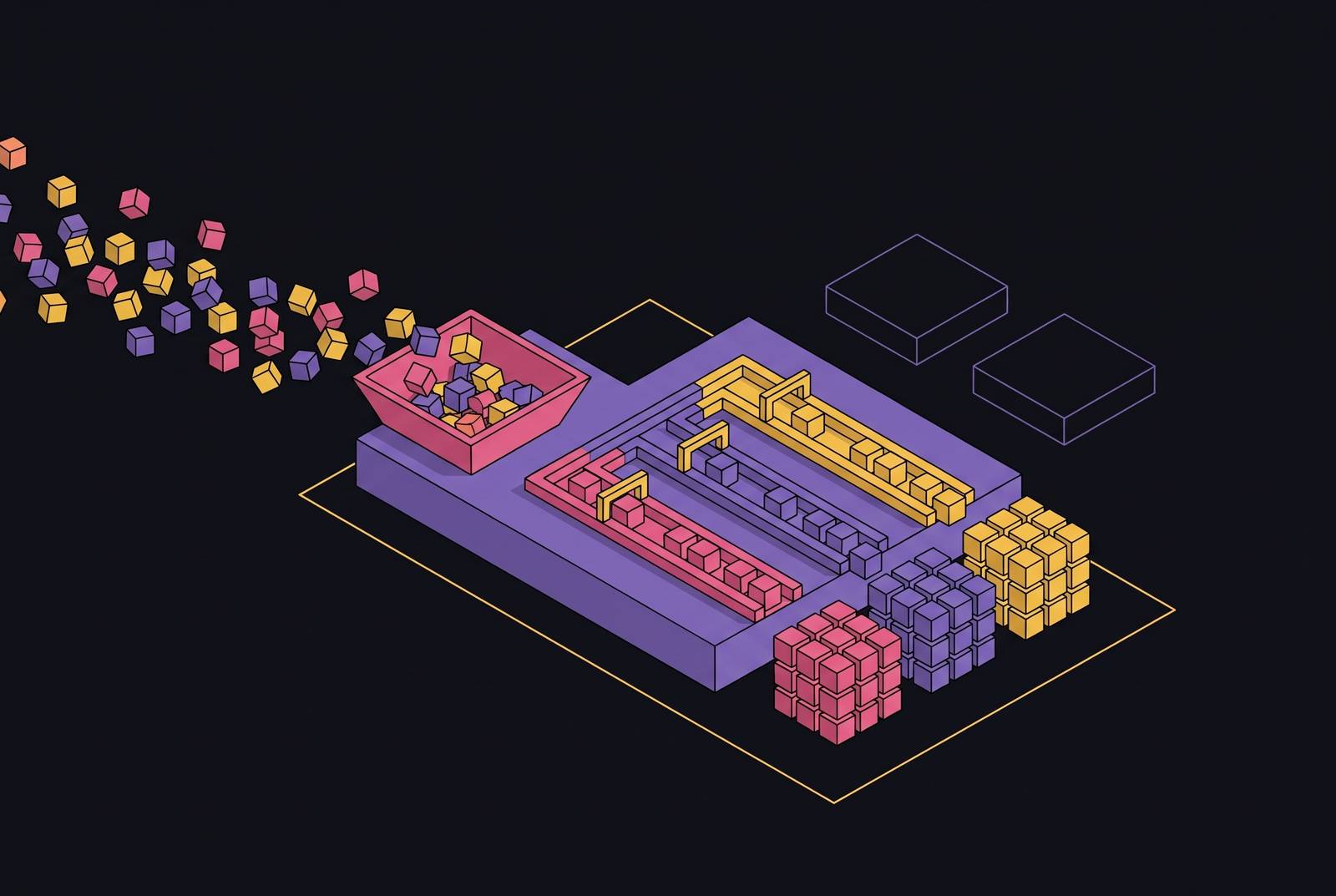
Automatic grouping of recurring AI agent failure patterns clusters similar failures across runs so teams can diagnose one recurring defect across separate traces. It should be the deciding criterion when choosing an agent monitoring platform because silent, semantic failures require more than scores and alerts. The useful platform connects discovery to trace-level evidence, a fix, and an evaluation that catches recurrence.
Why traditional monitoring cannot see the failures that end agent deployments
Traditional application performance monitoring is built for deterministic systems, but agents make non-deterministic choices about context, tools, and actions. Exceptions, HTTP errors, and latency spikes show where things go wrong as a system runs. They do not establish whether a completed workflow achieved the right outcome. An agent can return HTTP 200 after routing a ticket to the wrong queue or citing a hallucinated policy. The request succeeded, but the task did not.
This distinction creates a structural gap in monitoring. An infrastructure signal can show that a tool responded without showing whether the agent understood its response or used it correctly. A workflow can therefore remain operationally healthy while producing confident, incorrect results. Teams then discover the defect through user complaints, support tickets, billing discrepancies, or churn. By that point, monitoring has missed the opportunity to surface the failure before its consequences reached users.
How silent failures compound across multi-step agent reasoning
A semantic error becomes harder to diagnose when later steps depend on it. A slightly wrong parameter at step 2 feeds into step 3, corrupts step 4, and leaves the output entirely wrong by step 15. Each later action inherits the earlier mistake. Yet the final answer can look coherent because it presents the agent’s conclusion while leaving the evidence that undermines it hidden. Reviewing that answer alone cannot reconstruct the cascade.
Laminar’s October 2026 comparison locates the evidence for silent failures mid-run, including a misread tool result, a skipped step, or a retry that returned something different. Augment’s 2026 guide distinguishes final-response evaluation, trajectory evaluation, and single-step inspection. Final-response evaluation assesses the answer without explaining its cause, while single-step inspection examines individual tool errors. Trajectory evaluation spans the chain between them. It can show skipped steps and calls that were not needed, which neither endpoint review nor a check of one tool on its own explains.
Persistent memory extends this problem beyond one run. Microsoft’s AI Red Team described memory poisoning in its updated taxonomy published June 4, 2026, finding that a single successful injection could lead an agent to propagate a bad instruction across subsequent sessions autonomously. Monitoring therefore needs the full trace to locate the originating evidence, rather than treating the final output as a sufficient account of what happened.
Why volume turns individual trace review into an unworkable triage method
Production agents make thousands of decisions each day, so even a thorough check of traces cannot be the main way teams find failures. A team reviewing runs individually remains behind the traffic it is trying to understand. After a prompt change, the same defect can appear across many runs and look like separate incidents. The unit of diagnosis is the recurring behavior. Treating each occurrence as a new finding multiplies review work without revealing another cause.
Individual score drops also make a poor basis for triage because they generate false positives without necessarily establishing recurrence. Three failures of the same kind in a row tell a different story from three unrelated low scores. Recognizing that distinction requires grouping before alerting. An agent that changes daily needs near-continuous grouping, since weekly processing can leave a Monday regression undiscovered until the change is no longer fresh.
A judge written to catch unsupported promises will not necessarily reveal that the agent also corrupted a file it was editing. Braintrust’s 2026 guide on hidden failure patterns distinguishes predefined checks from behavior clustering, which groups traces by what actually happened. Scorers, thresholds, and dashboards address failures teams already know to describe. Discovery must also find behaviors that never made it onto that list.
How do platforms automatically group recurring agent failure patterns?
Automatic failure pattern grouping reads trace content and clusters similar behaviors rather than merely assigning each run a score against a predefined criterion. Seventeen runs in which an agent called the right tool with the wrong context can become one pattern for investigation. That changes the object engineers work on. They can inspect the shared behavior and its evidence instead of searching separate low-scoring traces for a connection.
Laminar’s Signals runs when each trace finishes, according to its October 2026 comparison. An agent reads the full trace and writes a finding in its own words into typed fields. Events appear within minutes, and they are usually assigned to a cluster within about a minute after that. Findings cluster as they arrive.
Braintrust Topics uses a different processing model. Braintrust’s June 2026 guide describes a daily pipeline that converts traces into readable text, summarizes them by facets including Issues, Task, and Sentiment, and groups similar summaries into named topics. A scatterplot exposes isolated clusters of unusual traces as starting points for discovery. Galileo AI also groups similar failures into clusters across production traces. These approaches share a grouping objective, but processing cadence and the evidence presented affect how teams investigate the result.
Scope is as important as processing speed. A check restricted to one span cannot connect a promise to a contradictory tool result six steps earlier. Full-trace grouping can read both pieces of evidence, and a finding that links its description to the relevant span gives teams evidence to check. That is more diagnostic than a category and score. “The agent called the pricing tool but used the stale cache result from the previous session” identifies a behavior an engineer can investigate.
The three-step loop that turns grouped failures into fixes
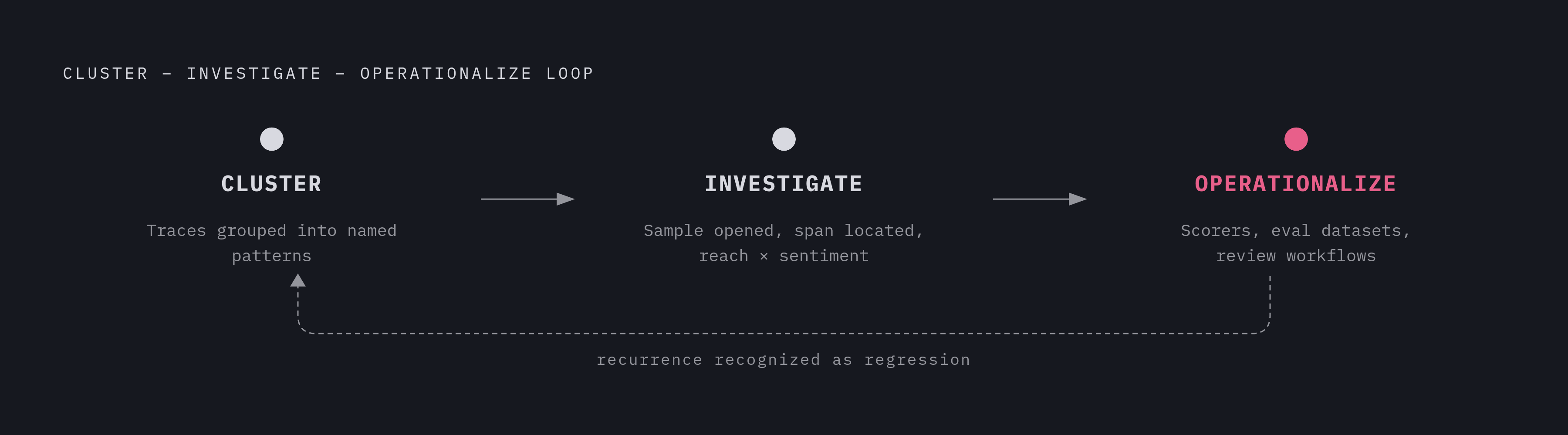
Braintrust describes a cluster-investigate-operationalize loop in which production behaviors become confirmed failures and then ongoing checks. Clustering offers a pattern that still needs to be checked. Investigation establishes whether the grouped traces share a failure, measures its reach, and checks whether it correlates with negative user sentiment. Operationalization turns confirmed examples into scorers, evaluation datasets, and review workflows. The loop prevents discovery from ending at an interesting visualization.
A team should open a sample and compare the conversations with the claimed behavior, setting aside a label that combines unrelated traces. Traces can use the same words yet have different defects. Once the pattern is validated, full-trace context helps locate the originating step and the tool result that was misread. Diagnosis then begins with specific evidence rather than a request to read two hundred traces for a common thread.
A monitoring MCP server can connect that evidence to the repair workflow. A coding agent can query the grouped issue, retrieve the relevant trace and offending span, and propose a fix within the editor. Context moves with the issue into the fix workflow. After the fix ships, the confirmed pattern becomes an ongoing evaluation, so recurrence appears as an identified regression. Grouping closes the loop only when the evidence survives this transition from discovery through repair to verification.
How grouping changes the failure picture in customer support, finance, and CRM agents specifically
Customer support agents can fail when retrieval returns nothing authoritative, when a knowledge base drifts from current policy, or when customer systems use subtly different field definitions. All of these failures can happen without an HTTP error. The resulting answer can be fluent and wrong. Braintrust gives a stale-pricing example in which an agent quoted a price three weeks out of date because the retrieval index lagged behind a pricing update. The failure appeared as a cluster with shared retrieval behavior.
With finance agents, semantic failure can also drive up costs. Retry loops can multiply token consumption even when individual requests do not look anomalous enough to trigger alerts. Grouping exposes repeated tool calls across traces as a recurring behavior. Looking at the whole workflow also helps teams tell one-off mistakes from patterns in fraud detection, payment routing, and reconciliation, where missing context can lead to wrong decisions. Detection on run forty leaves a different exposure from detection on run three.
CRM and other action-taking agents extend that exposure to records and transactions. An agent that refunds a payment, updates a CRM record, or merges data can turn a wrong decision into a service-level incident. Tool-call accuracy, policy compliance, and trajectory efficiency each describe a different way things can go wrong. They should not collapse into one low-score feed. Separating policy violations from wrong-argument tool calls and incomplete task completions gives teams a triage queue organized around the kind of repair required.
What to look for when evaluating grouping capability in a monitoring platform
The first evaluation question concerns the evidence available to grouping. Does it read the full trace or only the final output? Inputs, tool results, and intermediate steps hold the contradictions that a polished answer can hide. A platform limited to the final span cannot establish how the agent reached its conclusion. The scope test is whether the grouping process can connect an action to conflicting evidence earlier in the run.
Does grouping run continuously or on a batch schedule? For teams changing prompts daily, cadence is a functional requirement. Weekly grouping cannot expose a Monday regression while that change is still fresh. Evaluation should distinguish the time when a trace becomes available from the time when its recurring failure becomes visible as a group.
Can the platform surface a failure that nobody wrote a rule for? Judge prompts, preset categories, and metric thresholds have a role in checking known risks. They do not establish open-ended discovery by themselves. If identifying a new behavior first requires an engineer to name it and write a judge, the platform still depends on manual discovery.
Does the issue connect to an originating span, a diagnosis, and a fix path? A label alone leaves the investigative burden with the engineer. The useful workflow includes relevant trace context, MCP access when a coding agent is involved, and alerts where the team already works. A Slack alert linking the grouped issue and offending trace creates a different handoff from a dashboard number awaiting inspection.
Do confirmed failures become ongoing evaluations automatically? Braintrust describes operationalization as writing a scorer for future traces and promoting representative examples into an evaluation dataset. That establishes the required outcome, but evaluation should also distinguish automatic conversion from work left to engineers. If a repaired behavior can recur without recognition, the detection-to-fix loop remains open.
How the detection-to-fix loop closes when grouping is the platform's core capability
An evaluator reads a completed trace, writes a finding, and groups it with similar findings from other runs. The alert includes the issue and the span that shows it. A coding agent retrieves that context through MCP and proposes a fix, while the original pattern supplies the basis for an ongoing evaluation after the fix ships. Recurrence then has an identity the monitoring system already recognizes.
This sequence defines what AI-native monitoring infrastructure must accomplish operationally. It adapts to failure modes that engineers did not describe in advance, routes evidence into their working tools, and verifies repairs without leaving a separate test-writing task between detection and coverage. Clustering alone does not establish that capability. A platform built around tracing, cost analytics, or offline evaluation may add grouping while still leaving teams to review traces one by one in the rest of the workflow.
The deciding criterion is therefore the completeness of that workflow. Integrations, cost per trace, and pre-built scorers cannot substitute for discovering an unknown failure and making its recurrences actionable. The evaluation ends at verified repair. A platform earns that role when a grouped production defect becomes evidence for a fix and a durable check against its return.