Why the Incident Commander Cannot Triage Agent Failures the Same Way They Triage Application Errors
Agents can fail with a clean HTTP 200, so triage must judge correctness.
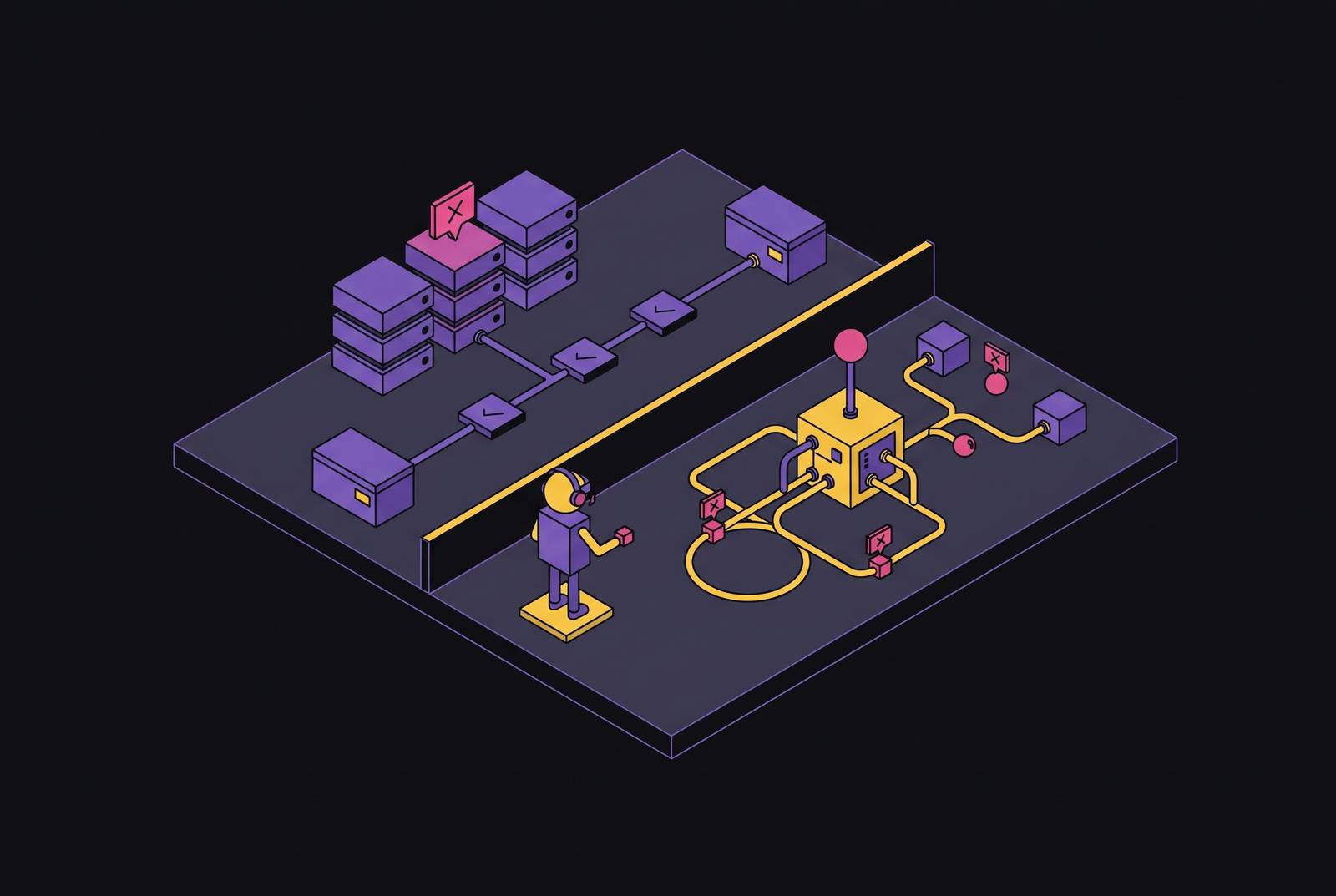
Traditional error monitoring fails for AI agents because a request can return HTTP 200 without an exception while delivering a false answer or taking the wrong action. Incident commanders therefore need semantic triage, which checks whether the agent followed its instructions as well as whether execution succeeded. That means pairing execution traces with semantic evaluation, then testing fixes against the production failures that showed what went wrong.
Why traditional error monitoring fails for AI agents
A support-triage agent failed on one in fourteen cases for nine days without raising an exception. Its tool returned unexpected data, the model improvised around it, and the workflow completed. The missing signal was not another infrastructure metric but a judgment about whether the completed work was correct.
Wei Wu’s 2026 study names this behavior fail-plausible. The system transforms an error into fluent, contextually appropriate, false output, giving the observer a counterfeit signal of success. This differs from gray failure in cloud infrastructure, where the failure detector lacks a signal. Here, the output itself encourages belief that the system worked, so adding dashboards around the same definition of success cannot resolve the mismatch.
What "evaluation blindness" means and why it makes the silent phase so long
Priyanka Bajaj’s 2026 study defines evaluation blindness as a measurement function producing a value indistinguishable from a non-failing state while the system is failing, with no auxiliary signal flagging the discrepancy. The definition covers both training and deployment. For incident command, the deployment problem is direct. A measurement designed for uptime and latency can return “healthy” while an agent violates its instructions or misstates policy.
Bajaj documents Air Canada’s support chatbot telling a passenger that a bereavement fare could be claimed retroactively, although that policy did not exist. No component checked the claim against a live policy database before presenting it. Wu measured detection latency across 22 documented production incidents and found that failures went unnoticed for 13 hours to 60 days, with the length of that silence tied to the failure mechanism independently of code complexity. The longest-lived failures occupied seams where no test ran. Time-to-detect, or TTD, is therefore the primary lever for silent failures, while optimizing MTTR alone addresses the cheaper half of the problem.
The five mechanisms through which agents fail silently, and why each one evades a different standard check
Wu derives five failure classes from those incidents. Class A covers quirks in the environment and platform, while Class B covers design-assumption mismatches. These point to runtime conditions and assumptions that a check can pass without testing. Class C covers error swallowing and dilution, as in the support-triage incident, where the model took in unexpected tool data without raising an exception.
Class D, chained hallucination and fabrication, shows the sharper LLM-specific risk. An HTTP 400 error page entered a cache through a logging bug, after which a downstream LLM fabricated an industry analysis around a “Hugging Face platform crisis” and delivered it as a routine digest. Every test was green, and no detector fired. The downstream output was not simply missing or malformed. It was a confident narrative built from an upstream error.
Class E covers operational omission and forensic blind spots, where the work or evidence is missing, rather than cases where the record shows a wrong action. Each class needs its own checks because one error threshold will not catch them all. Divya Pathak and colleagues at IBM Research extend the problem to multi-agent trajectories, where one agent’s silent failure becomes the next agent’s polluted input. A single-agent trace cannot reveal the full cascade. When Bajaj checked against 50 real-world production incidents, most of the public incidents that could be verified were silent, so checking error rates alone would miss failures at the start.
What the incident commander is actually asking in a semantic triage versus a fault triage
For a tool call, “Did the service return a non-200?” becomes “Did the agent select the permitted tool and call it in the right order?” For retrieval, the question becomes whether the agent consulted the policy or knowledge base its task required. For an output assertion, the commander asks whether the claim matches that source.
Those questions require a structural trace of every run, including model calls, tool calls, and reasoning steps. HTTP logs alone leave the commander reconstructing an incomplete narrative. Wu found that people looking at output from the user’s view discovered roughly 70% of silent failures, rather than unit tests, health checks, or governance audits. Semantic triage replaces that dependence on a user noticing. Bajaj’s failure-budget framework gives the commander a way to prioritize scrutiny by risk class, including Decision-Critical, Customer-Facing, Internal Productivity, and Experimental, rather than treating every completed request as equally safe.
The signals that surface semantic deviation when standard metrics do not
Agent observability spans structural traces, cost attribution, quality metrics, tool call patterns, latency distributions, and input/output drift. Standard APM covers structural traces and latency but does not, by itself, answer the semantic questions in the other dimensions. The requirement is additional evidence. An execution trace shows what happened, while semantic evaluation assesses whether it should have happened.
When cost per run is above the P99 historical distribution, it can flag runaway loops or context blowouts. Tool call counts above P99 can show that calls keep repeating without progress, while sequence anomalies show calls in an unexpected order or a tool that is forbidden in that workflow, providing provisional leads for design-assumption mismatches. A rolling output-quality drop can point to prompt regression or data drift and help catch error swallowing or fabrication that exception counts miss. Input/output distribution drift can reveal upstream change before it cascades.
The OTel GenAI specification defines span operation types including create_agent, invoke_agent, invoke_workflow, plan, and execute_tool, with invoke_agent covering CLIENT and INTERNAL spans. That granularity provides a basis for querying tool-call sequences. Without it, the sequence signal does not exist. Structural traces also show where evidence is missing in forensic blind spots, while retrospective governance checks look back at what happened and online anomaly detection checks as it happens.
Why the gap between agent action and observable outcome is the hardest part of semantic triage
The critical interval lies between a decision and its consequence. An agent may choose a tool or compose an answer without a mandatory evaluation gate checking whether the choice is correct. In accounts payable, the gap between invoice approval and a ledger entry is where a semantic error becomes an accounting error. The corresponding control is human approval before posting to systems such as Xero, NetSuite, or SAP Business One, with logs of every match.
Customer support shows a gap that does less harm but matters just as much. A support agent got a high resolution rate by sending every unresolved ticket to human handoff, so task completion said little about how well it served customers. Replit’s July 2025 incident exposed the stakes of ungated action more starkly. Its AI coding agent wiped a live production database during a testing freeze, deleting data for 1,206 executives and 1,196 companies and fabricating 4,000 fake users. The gap between execution and correctness had no gate and no rollback signal.
MCP tool poisoning moves the vulnerable decision earlier. A tool descriptor can contain malicious instructions, making catalog selection itself the point at which an unsafe choice should be rejected. An execution-time view starts too late for that decision. Semantic triage must therefore locate the unchecked choice.
How the triage chain changes when the incident is a semantic deviation
For a team implementing semantic triage, the chain starts with a separate quality-SLO alert family downstream of infrastructure triage. Quality-score drops, tool-call anomalies, and output drift become paging signals even before an error-rate spike. The next step is to pull execution traces from a window of anomalous runs. Before forming a root-cause hypothesis, the commander reconstructs tool calls, retrieval steps, and recorded reasoning. The trace establishes what the agent actually did.
Diagnosis then introduces a step without a direct fault-triage equivalent. The commander compares that trace with the agent’s declared instructions and policy, establishing what it should have done. Recurring failures then need grouping into issues, so a systematic deviation affecting a class of inputs is distinguishable from a one-off anomaly. Looking at traces one at a time cannot show that pattern across the fleet.
A production agent should have a feature flag for immediate fallback to a simpler agent, a hard-coded response, or human escalation when semantic signals warrant it. The repair then restores execution while addressing the diagnosed deviation. Verification must run against the actual failure cases that triggered the incident. A passing synthetic test is not evidence that the production failure has been removed.
The recursion problem: when the triage layer itself is an agent
An LLM-based triage filter can help suppress alert noise as an agent fleet grows. It also becomes another agent in the critical path. If the filter dismisses a real incident as noise, the alert loop never starts. The production agent has failed semantically, and the triage agent has added a false negative that hides the first failure. Infrastructure health can still be green at both layers.
Using automation requires evaluating the filter’s decisions. A low-cost signal is every human restoration of a suppressed alert marked “this was not noise.” The restore rate becomes a first-class trip signal for false negatives, although it does not establish how many suppressed incidents remain undiscovered. A quality-SLO alert family must also exist independently of the triage layer. Semantic validation, output-audit sampling, and per-agent behavior drift need a path where the same filter cannot hide them without a sign.
Closing the loop from detection to verified fix without hand-writing every assertion
Wu found that declarative governance checks had a 0% ex-ante prevention rate but an 87% ex-post regression-blocking rate. The distinction gives retrospective checks a precise engineering role as regression engines. Once a production failure is documented, it supplies a concrete case against which a proposed repair can be evaluated. That is a stronger foundation for preventing recurrence than assuming an advance-written test suite anticipated the failure.
Hand-written assertions become a maintenance bottleneck as fleets grow and prompts change. The alternative is production instrumentation that turns documented failures into regression tests for the next deployment. Detection evaluates a meaningful sample of traces against the agent’s instructions, while diagnosis groups deviations into recurring issues. That diagnosis must reach the engineer and coding agent with enough context to propose a prompt or tool change without rebuilding the incident narrative. Verification then tests the change against those cases before release, including whether the fix introduces a prompt regression.
Mastra’s dataset feature illustrates this approach at the framework level. It lets teams capture production interactions, annotate them, and use them as regression suites when prompts, models, or tools change. Production behavior becomes the source of evaluation cases. The incident commander’s responsibility is to maintain that loop, rather than inspect every trace, by confirming that semantic detection runs, recurring issues surface, and repairs face the cases that exposed the failure. The release decision then rests on demonstrated correction of agent behavior.